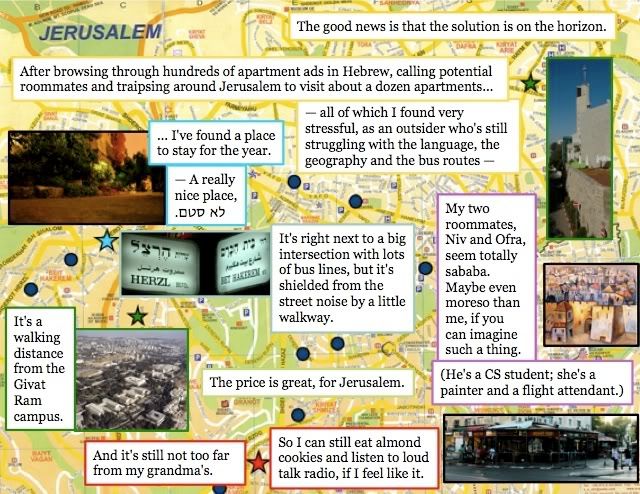
01 November 2008

ואלס עם באשיר

Last week, my grandmother and I went to the Lev Smadar cinema in the German Colony to see Waltz with Bashir, an animated film that explores themes of war, trauma, cruelty and innocence through interviews with IDF soldiers who witnessed the Sabra and Shatila massacre.

It took me and my grandmother two tries to see this movie. The first time, the theater was actually showing Caos Calmo instead. Since the Smadar is a one-theater cinema, we bought tickets for "the movie" at the box office. We didn't realize we'd made a mistake until, several minutes into the movie, it dawned on us that the live-action Italian film we were watching really was the main feature. (20 minutes in, my grandmother leaned toward me and said, a little too loudly, "I don't think this is Waltz with Bashir!") But we decided to relax and make lemonade from the lemons we'd been dealt, as they say. We'd come back for Waltz with Bashir another time.

This is all by way of saying: Waltz with Bashir was incredible. I was expecting something like Waking Life (which I found disappointing). But in fact, this film was more like an Israeli Grave of the Fireflies. I think everyone should watch it, but particularly those of you who are interested in genocide, or the military, or Middle Eastern politics, or the psychological effects of trauma.

Here's a trailer, in case my sales pitch didn't convince you:

31 October 2008

סוף-סוף סוף לבלגן

Two days ago, I got an email from LRS, asking when she might be able to come visit. (!!) I answered:
Can I get back to you on that one?

The semester was scheduled to start on Sunday, but the university has informed the students that the semester will be delayed "until further notice."

Two years ago the whole school year was delayed by a student strike over raised tuition; last year the already-delayed school year was pushed back even further by a faculty strike over low wages. This year, the institution of higher education itself announced that it's striking for a bigger cut of the national budget, but...


Well, a few weeks ago the old Israeli prime minister (Ehud Olmert) stepped down because he was mired in a huge financial scandal, and the governing party elected a temporary prime minister (Tzipi Livni) to replace him. But she only gets to stay prime minister if she can put together a new parliamentary coalition before a certain deadline. The deadline was two days ago, and she couldn't do it, so now Olmert is back in power, leading a transitional "care-taker" government until the ad-hoc elections, which I think are scheduled to be in February (to give everyone lots of time to campaign).
[Here's the relevant Wikipedia article, with a much better explanation than mine.]

I'm pretty sure that the care-taker government does not have the authority to authorize budgetary changes. If so, the university had better not strike, since no one will have the power to meet their demands anyway! Hopefully they'll step down in the next few days, and start the semester on schedule, and then I'll know — at least tentatively!! — what this year's academic schedule is.

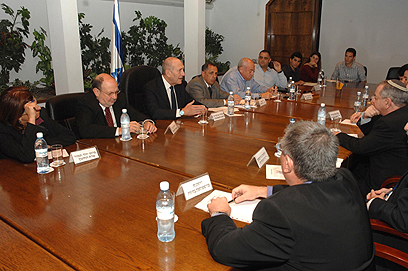
It turns out I was wrong about the legislative power of the care-taker government. Yesterday morning, as I got on the bus to the market, I heard the news on the bus driver's radio: "Emergency budgetary changes approved, academic semester to begin on Sunday." Sure enough, on his third day back in office, Olmert called an emergency budgetary session and approved the budgetary changes that the universities were asking for.

That's the actual budget meeting! Not my photography, haha.

Sure enough, this appeared in my email inbox yesterday night:

No explanations or apologies. Just one line:
"On Sunday, 11/2/2008, the 5769 school year will commence on schedule."

Which means my academic semester will officially begin at 4:30 on Sunday, with "Between Law and Moral and Political Philosophy." Or for short ... ?במלאפ"ף Bamla'apaf? Come to think of it, what in the world are the students going to call this class?

30 October 2008

מתאזנת

(continued from this post.)

As you know, Bob, culture shock is a central component of the study-abroad-experience. Still, my own personal culture shock is shaped by the fact that I spent the last four years living in one of these:


The 1500 students at my liberal arts college were far from univocal when it came to identity politics, but we all had a sense of common ground to push off of in our disagreement, including a mostly-shared conception of tolerance and more-or-less similar ways of conveying respectful disagreement. Predictably enough, now that I'm out of the bubble (and outside my national bubble, and lately outside of the academic bubble) I've been finding myself frustrated with the rift between the assumptions I make and those that some of my Israeli partners in conversation make when we talk about identity politics.

What to do? I went to the HUJI library and checked out this book that my college thesis advisor wrote, called Tolerance: Between Forbearance and Acceptance.


Did you need any confirmation that I'm a philosophy dork? Now you have it.

When people find out that I study philosophy, they'll often ask what I plan to do with my education. I have a few canned responses to those kinds of questions — most of which are just cheerful concessions — but the most honest response is that philosophy clarifies my understanding of my circumstances in a way that is very important to me. The experience of reading this book here in Israel has offered me a great reminder of how important a role philosophy plays in my personal life.

A few encounters with rough edges of Israeli culture — especially in conversations about identity-politics — have left me struggling to find a balance between respect and resistance. It's sort of like learning personal-space boundaries in a new culture (how far to stand from someone when you're having a conversation, or how long to hold a handshake). Except in this case, I'm learning how far to stand from my own heart, and how much to thicken my skin, cool my blood and respond indifferently to (what-strikes-me-as) prejudice or intolerance. [Ruth blogs a similar struggle in Syria.]

The frustration and disappointment that I feel after these sorts of encounters has been hugely compounded by the fact that I don't know what kind of behavior I expect from myself in a situation like that. It's one thing to make judgments and keep them to myself. But the whole mutual-understanding-between-cultures thing seems to demand that I refrain from imposing my culture's value judgments on others. How can I refrain from making judgments without betraying my moral commitments?


And that's where this book comes in. I'm just going to be self-indulgent and quote it at length, because this particular section helped me so much to understand where my frustration was coming from, and where I hope to go from here.
To be fully tolerant does not entail that we cannot have critical reactions to the content of the attitudes, thoughts or conduct of those tolerated. All forms of tolerance necessitate having critical reaction to that which we tolerate. Otherwise, we would be either totally indifferent, complacent, world-weary, or fully accepting. Nor should "critical reactions" be limited to private, unexpressed responses. The fully tolerant do not — as do the barely and merely tolerant — deny themselves the opportunity, even the responsibility, of critically engaging those whom they tolerate, for the fully tolerant value more than that one lives one's own life. [...] It is enormously important that one's life has value, not merely that it is one's own.

Because those with a liberal temperament value individuals trying to live out their own conceptions of a good life, we might sometimes help individuals and groups pursue their good even when we find it deficient in various ways. [...] Full tolerance, therefore, involves a deep respect for the individuals and communities whose life projects are different from on's own, even where one disapproves of elements in it, even thinks that it is a generally inferior way to live. Full tolerance is not acceptance. The fully tolerant recognize, however, that it is usually difficult to remove objectionable elements from a system without destroying the whole. They will be acutely aware of what I call the "Sweater Principle": We sometimes pull on an offending bit of thread marring our sweater only to find a shapeless heap of yarn at our feet.

The fully tolerant, finally, recognize that there can be much good — though a diferent good — in attitudes, beliefs, and ways of life that we ourselves do not find congenial. It is not htat we do not see what is regrettable, say, about an Amish way of life. We see that all too clearly.What we may overlook are the incredible strengths in that way of life, the values — again, perhaps markedly different from our own, maybe even in competition with them — that it instills. Their way of life is not ours, but we see that it enables Amish to live rich, constructive live. This does not mean that the Amish themselves are imbued with a liberal temperament. Having a liberal temperament is neither a necessary nor a sufficient condition for living a worthwhile life. Having a liberal temperament, however, can help one see the value in ways of life and systems of belief that are not, themselves, liberal in any respect.
(Hans Oberdiek, Tolerance)

18 October 2008

B'Culture Shock [...o-b'sakit]

My last post (so long ago!) drew worried comments from some Americans who like me and worry that I might never come back. Aww! Let me assuage your fears with a blurry graph:


That's from the tail end of the ʇɥbıɹq1nɟ orientation in DC. The graph's titled "Pattern of Adjustment," and it plots Satisfaction against Time. (What are the units on the y-axis?!) As you can see, we visitors of foreign cultures predictably become infatuated with our host country, and then our moods come crashing down into the Valley of Great Dissatisfaction, from which we eventually emerge... only to plunge into the Even Deeper Valley of Horrible Sadness when we experience reverse-culture-shock back at home.

Fellow-fellowshipper Mitch-in-Egypt puts it this way — "Being in Cairo like being in a relationship with another person.... You might find it fascinating in the beginning, and then not so much later on."

It's not just Cairo, of course. I find myself marking little benchmarks-of-culture-shock.
  • Random feral cats all over the place? No longer the Cutest Infestation Ever. The more dead/starving/diseased street cats you see, the less you want to snuggle up with the healthy-looking ones.
    I was walking around Jerusalem yesterday and saw part of a cat lying in the middle of an intersection. There was nothing cute about it.

  • The thrill of public transportation? Basically gone. I think that I lost my appetite for bus travel after I spent 50 minutes shivering in the windy Jerusalem dusk while I waited for line 17, which (it turns out) takes the longest possible route between Beit Hakerem and Rechavia. I could have walked it and gotten there almost twice as fast.

    And the classic Israeli game of shoving your way onto the bus becomes much less fun after you lose, and get stuck waiting another twenty minutes for the next bus.

  • Gefilte fish. I do not have very much to say about it, except that I really hope I stop being sick of it in time for Passover.


    That's my grandma, making gefilte fish by grinding up fish into little shivering worm-like things. Honestly, my grandmother's gefilte fish are amazing, but we ate them for breakfast lunch and dinner throughout the עשרת ימי תשובה period.

  • Aggressive flirting from random dudes, especially dudes who are trying to sell you something? Not even mildly amusing anymore.

    Except, okay, there was one time when I got on a train and I really wanted to be left alone, so I sat across from an oldish guy who was wearing a white shirt and a black velvet kippah, which normally signals a strong predisposition against chatting up girls in tanktops. As I sit down, the dude announces a heavy Russian accent that his name is Moshe and he "needs to get married very urgently," and gives me his card, which is actually just a piece of cut-out printer paper advertising his services as a "therapeutic masseuse for men only." That... was pretty amusing. But still: random dudes, cut it out!


    If you don't know why I chose a photo from Machane Yehuda for this one, you have probably never been a 20-something-year-old woman at Machane Yehuda. For every obnoxious remark from a sales-dude, I think a customer-lady should be entitled to a date. (The fruit kind, not the other thing.)

But most of all I am getting worn down by a bunch of conversations I keep having, which generate a lot of friction and never seem to get anywhere. Chief among these are:
  • Arabs / Muslims / Palestineans: their dispositions, their cultural contributions, etc.
  • Feminism.
  • התבוללות (intermarriage between Jews and gentiles).
I don't want to avoid these conversations — and anyway, I can't — but I need to find a way to have them more productively.
(To be continued!)

29 September 2008

[ʃaˈna toˈva] ! שנה טובה

Big transitions! On Tuesday, it rained for the first time since I've been in Israel. Wednesday was the last day of Ulpan, on Thursday we took our final Hebrew exams, Friday I started moving into my new apartment, yesterday I finally got my apartment keys before hopping on a bus to Tel Aviv and a train to Binyamina, where my uncle and aunt picked me up and drove me to their house in Zichron Ya'akov. Tonight we're driving to my uncle's wife's sister's house for a huge dinner, to celebrate the eve of the 5769th anniversary of the day that God created Man.

I hate to sound like an Aliyah recruiter, but I have to admit that the weeks leading up to Rosh Hashana have never felt as special out there in the diaspora as they do here. It's like Thanksgiving, Christmas and New Year's all rolled up in one, except that it's surprisingly uncommericialized, and it's Jewish. The media's buzzing with retrospectives and excitement about the future, the roads are clogged with cars headed to family reunions, the supermarkets are stocked with holiday food like pomogranates and honey cakes, and everyone greets everyone with well-wishes for the new year. ("A sweet and rainy year!" is one I've heard more than once.)

I've had a mix of very good and very bad luck leading into the holiday. The good news is that I'm getting to celebrate with both sides of the family. I'm having dinner with my mom's family tonight, which means I'm missing my dad's family's R.H. Eve dinner in Mode'in (near Jerusalem). But tomorrow, on the first day of Rosh Hashana, my uncle's driving me to Jerusalem to visit his father (my grandfather) — and then I'll spend the rest of the holiday with my dad's side of the family. A stunt like that would normally be impossible to pull off, since public transportation doesn't run during the holiday. (Classic.)

Another really cool detail in this plan is that I'll get to see both a religious and a secular take on the holiday. My aunt's sister, who's hosting tonight's dinner, is a formerly-secular now-Orthodox Jew (i.e. חוזרת בתשובה). So tonight we'll be ushering in the new year by The Book, with candles and kiddush and prayers and everything, whereas tomorrow's dinner will be more mainstream Israeli. Other than gefilte fish, I'm not really sure what to expect from either one.

The bad news is that I managed to hit my first serious bout of food poisoning just as I got on the bus to Zichron yesterday. So I arrived here a few pounds lighter, trembling a little, whereas my breakfast, lunch, and previous night's dinner didn't make it as far as Binyamina. My aunt graciously sent me to bed early with a mug of boullion-chicken-soup. (Chicken soup for stomachaches must be an American thing, cause my aunt was puzzled by the idea. "Really? Whatever you want, but I'd never eat that stuff. You know it has no nutritional value, right?") I woke up in the wee hours, when my digestive system decided to side with her, against me and the soup. "Don't worry, metuka," said Noam, on the phone from Jerusalem. "Your body is getting rid of all the bad stuff in preparation for the new year. Next year you'll feel much better." "Next year," I said, "we'll sit on the porch and count the migrating birds." "Isn't it great to talk about next year, knowing that it starts tomorrow?"

Anyway, ה'תשס"ט hasn't rolled in yet, and I'm already feeling much better. Today, I've been taking it easy, trying to get rehydrated. This Israeli household, like every other, is equipped with Wissotzky tea to the exception of any other brand. But I have to admit — Wissotzky Bedouin Chai? With soy milk? Delicious.

26 September 2008

You know...

If I had one wish that I could wish this High-Holiday season, it would be for all the children in the Land of Israel — Palestinean or Israeli, Sephardic or Ashkenazi, Druze, Mormon or Brezlov — to join hands and sing together in the spirit of harmony and peace.

But if I had two wishes I could make this High-Holiday season, the first would be for all the children to join hands and sing in the spirit of harmony and peace. And the second would be for public transportation on Saturday.

22 September 2008

There was a terrorist attack in Jerusalem a few minutes ago, near the old city. I have nothing clever or interesting to say about it. I just wanted to let you know that I'm fine.

19 September 2008

The big shot of the Babylon-Jerusalem Axis

My grandmother is blasting Barbara Streisand. Apparently love will be the gift you give yourself? Not earplugs?

My grandmother has been sharing her house with me for almost two months now, and it should surprise no one that our 58-year generation-gap is sometimes difficult to bridge. Some days I come home and find that the political analysis playing in the kitchen is competing with news on television, commercial jingles from the bathroom, and nostalgic Israeli tunes wafting out of my grandmother's bedroom. "Are you hungry?" she shouts over the noise, beaming and extending a spoonful of beige.

So I've been surreptitiously turning off radios when she leaves the room, and she's been surreptitiously folding my clothes while I'm away at school. It's not really a solution, but it's a perfectly good band-aid.

[By the way, as I type this, my grandmother tells me that she's going downstairs to visit a neighbor. Excuse me while I shut off the Barbara Streisand CD and throw it out the window.]


For now — Baya's back home, and Barbara Steisand's back at full volume, struggling to be heard over the news.

I'm going to Zichron.

18 September 2008

Faux Amis Friday

Welcome to the latest issue of Duckrabbit in Jerusalem, the blog where we wonder what's going on with רוני, who is Just Too Busy To Tell Us! Today's episode is about faux amis, and it goes out to everyone who's been putting up with my unresponsiveness to emails, facebook messages and wall posts. Soon I'll move to an apartment with internet, and things will be better! Until then... faux amis.

Faux amis means "false friends" in French. That's what I hope people don't conclude about me when I exercise poor internet ettiquette! Heh. Faux amis also means "words in different languages that sound like they should have the same meaning, but don't." Second-language learners find faux amis everywhere. They help us stay awake during language classes.

Hebrew and Engish have a surprisingly long chain of faux amis threaded through the pronouns. An American rabbi wrote a cutesy Abbott-and-Costello tribute about it:
Abbott: הוא is he.
Costello: Who is he?
Abbott: Precisely.
Until someone pointed those out to me, I never noticed them, and I still don't think they sound that much alike. Anyway, there are a lot of crazier faux amis for advanced Hebrew-learners to giggle about in Ulpan. Ahem:
  • Nylons (ניילטנים) are the plastic bags you get from the grocery store.
  • Purée (פירה) is mashed potatoes.
  • Bagel (בייגלה) means bagel, but it also means pretzel.
  • Philadelphia (פילדלפיה) means Philadelphia, but it's also the generic name for cream cheese.
  • A trapeze (טרפז) is a trapezoid.
  • An American exam (מבחן אמריקני) is a multiple-choice test.
  • A close (קלוז) is a fill-in-the-blank exercise.
  • Your lose (לו"ז) is your schedule.
  • A sniff (סניף) is an outlet of a business.
  • A filipina (פיליפינה) may be someone from the Phillipines, or she might just be anyone whose job it is to take care of old people. [!עיין ערך גיזאנות]
  • Sponge (ספונג'ה) is the name of the job where you clean other people's houses.
  • Mommy (מאמי) and boobie (בובי) are terms of endearment.
  • The vestigal structure attached to the end of your colon is called your appendicitis (אפנדציטיס). If it gets infected, you have appendetzit (אפנדציט).
  • Sylvester (סילבסטר) is the name of the holiday you celebrate on December 31st. ("New Year's Eve" is the name of the holiday we'll celebrate on September 29th.)
And finally...
  • Rashomon (רשומון) is the name of an important Japanese movie, but it's also the Hebrew word for "blog."
I've collected some more, too, but
From Jerusalem, Israel, I'm Duckrabbit and this has been Faux Amis Friday. Come back next week for reduplicative onomotopoetics! (And possibly news from my exciting life?) Same bat time, same bat rashomon.

08 September 2008

Chocolate milk in a plastic bag

Instead of running to catch the bus this morning, Yahm and I hopped into the grocery store and got ourselves some Israeli staples. As we waited the next bus to crawl up the hill, I drank my first-ever shoko besakit. This, לכאורה, makes my life complete.