Showing posts with label racism. Show all posts

08 November 2008

Obama in translation

In my American-media-gorging over the past few days, I hear a lot of Americans proudly claiming that "it couldn't have happened anywhere else in the world." Out here in The World, people really are posing the question. Could what happened in the US on Tuesday have happened here in Israel?

Is that question even sensible? What would count as the "same thing" happening here?

photo credit: NYT, from a May 13 Yom Ha'atzmaut event in DC

Let me postpone the central and fascinating racial issue for the next post. Before I get there, there's another difficulty: Israel doesn't have a directly-elected head of state. Israel's president is a symbolic figurehead, elected by the Knesset, and the prime minister, though formally appointed by the president, is actually just the leader of whichever party wins the most Knesset seats. (Fascinating Fact: Israel actually implemented an American-style head-of-state direct-election system from 1996 to 2003, but then they scrapped it and reverted back to the earlier system.)

People do directly elect political parties, and some political parties are explicitly designated as representing the interests of particular minorities. For example:
So someone could plausibly suppose that a US08-equivalent Israeli election outcome would be a Knesset where a plurality of seats are held by a party like UAL, Shas or maybe Atid Echad.

In fact, it's not so at all. The demographically-oriented Israeli political parties take care of their own. So when Obama said, "I may not have won your vote, but I hear your voices, I need your help, and I will be your President too" — he was articulating an American conception of political constituency. By contrast, Israel's minority parties are understood as responsible to their electorate, and maybe even to their whole demographic base... but not to the whole country. So long as they hold few seats in Knesset and are forced to bargain hard for political gains, that's fine. But no reasonable Israelis are fantasizing about a Shas-led government.

What people are imagining is a political victory by a major party headed by a suitably-Obama-ish prime minister. And what does that PM's Obamaishness consist in? S/he's got to belong to a minority whose status in Israeli society is somehow equivalent to that of Black Americans. And that opens up a truly fascinating question: does Israel even have plausible analogues for US racial categories?

(To be continued!)

30 October 2008

מתאזנת

(continued from this post.)

As you know, Bob, culture shock is a central component of the study-abroad-experience. Still, my own personal culture shock is shaped by the fact that I spent the last four years living in one of these:


The 1500 students at my liberal arts college were far from univocal when it came to identity politics, but we all had a sense of common ground to push off of in our disagreement, including a mostly-shared conception of tolerance and more-or-less similar ways of conveying respectful disagreement. Predictably enough, now that I'm out of the bubble (and outside my national bubble, and lately outside of the academic bubble) I've been finding myself frustrated with the rift between the assumptions I make and those that some of my Israeli partners in conversation make when we talk about identity politics.

What to do? I went to the HUJI library and checked out this book that my college thesis advisor wrote, called Tolerance: Between Forbearance and Acceptance.


Did you need any confirmation that I'm a philosophy dork? Now you have it.

When people find out that I study philosophy, they'll often ask what I plan to do with my education. I have a few canned responses to those kinds of questions — most of which are just cheerful concessions — but the most honest response is that philosophy clarifies my understanding of my circumstances in a way that is very important to me. The experience of reading this book here in Israel has offered me a great reminder of how important a role philosophy plays in my personal life.

A few encounters with rough edges of Israeli culture — especially in conversations about identity-politics — have left me struggling to find a balance between respect and resistance. It's sort of like learning personal-space boundaries in a new culture (how far to stand from someone when you're having a conversation, or how long to hold a handshake). Except in this case, I'm learning how far to stand from my own heart, and how much to thicken my skin, cool my blood and respond indifferently to (what-strikes-me-as) prejudice or intolerance. [Ruth blogs a similar struggle in Syria.]

The frustration and disappointment that I feel after these sorts of encounters has been hugely compounded by the fact that I don't know what kind of behavior I expect from myself in a situation like that. It's one thing to make judgments and keep them to myself. But the whole mutual-understanding-between-cultures thing seems to demand that I refrain from imposing my culture's value judgments on others. How can I refrain from making judgments without betraying my moral commitments?


And that's where this book comes in. I'm just going to be self-indulgent and quote it at length, because this particular section helped me so much to understand where my frustration was coming from, and where I hope to go from here.
To be fully tolerant does not entail that we cannot have critical reactions to the content of the attitudes, thoughts or conduct of those tolerated. All forms of tolerance necessitate having critical reaction to that which we tolerate. Otherwise, we would be either totally indifferent, complacent, world-weary, or fully accepting. Nor should "critical reactions" be limited to private, unexpressed responses. The fully tolerant do not — as do the barely and merely tolerant — deny themselves the opportunity, even the responsibility, of critically engaging those whom they tolerate, for the fully tolerant value more than that one lives one's own life. [...] It is enormously important that one's life has value, not merely that it is one's own.

Because those with a liberal temperament value individuals trying to live out their own conceptions of a good life, we might sometimes help individuals and groups pursue their good even when we find it deficient in various ways. [...] Full tolerance, therefore, involves a deep respect for the individuals and communities whose life projects are different from on's own, even where one disapproves of elements in it, even thinks that it is a generally inferior way to live. Full tolerance is not acceptance. The fully tolerant recognize, however, that it is usually difficult to remove objectionable elements from a system without destroying the whole. They will be acutely aware of what I call the "Sweater Principle": We sometimes pull on an offending bit of thread marring our sweater only to find a shapeless heap of yarn at our feet.

The fully tolerant, finally, recognize that there can be much good — though a diferent good — in attitudes, beliefs, and ways of life that we ourselves do not find congenial. It is not htat we do not see what is regrettable, say, about an Amish way of life. We see that all too clearly.What we may overlook are the incredible strengths in that way of life, the values — again, perhaps markedly different from our own, maybe even in competition with them — that it instills. Their way of life is not ours, but we see that it enables Amish to live rich, constructive live. This does not mean that the Amish themselves are imbued with a liberal temperament. Having a liberal temperament is neither a necessary nor a sufficient condition for living a worthwhile life. Having a liberal temperament, however, can help one see the value in ways of life and systems of belief that are not, themselves, liberal in any respect.
(Hans Oberdiek, Tolerance)

27 August 2008

שדות מוקשים סמנטים

(continued from here)

Political correctness is a hot topic here in the Ulpan. By my lights, it’s incredibly important to spend class time developing a politically-sensitive ear, because Hebrew's ֿsemantic [mine]field is studded with complicated and potentially hurtful connotations.

For example, people here use two different words for Palestineans: “falestinim” and “falestinayim.” I’ve heard that among younger Hebrew speakers, the first pronunciation connotes support for the Palestinian people, whereas the second pronunciation is either neutral or negative in connotation. The city-name of Haifa does a similar sort of thing. Some speakers use the original Arabic pronunciation (which sounds very close to the English). Others use the Hebrew-ified version: “chey-fa.” You can probably guess what pragmatic payloads those pronunciations tow.

Students in advanced Ulpan classes need to learn able to control the allegiances expressed by our word choices. But it’s not always clear how to do so. Sometimes my American political awareness serves me well: I have no problem saying מאיותגר (challenged) instead of מפגר (retarded) — and, indeed, avoiding both of them and using a more specific word if I can.

But often enough, my political conscience seems to misfire. For example, Hebrew uses adjectives that express group membership as singular nouns to refer to individual people — “that Sephardic” — and as plural nouns to refer to groups — “those Filipinos.” In English, I would absolutely never use an expression like “that Black,” or “those gays.” In Hebrew, even conscientious leftists seem to regard those expressions as wholly unproblematic — just like “that Muslim” or “those Americans.” (And even there, I prefer “that Muslim guy” or “those American tourists.”)

It gets worse. “Those Filipinos” are only sometimes an ethnic group. Hebrew also uses “Filipino” to refer to anyone who takes care of elderly people in private homes, regardless of their race. Apparently, an overwhelming majority of Filipino residents of Israel work in those sorts of caretaking jobs, and conversely, occupants of those jobs are overwhelmingly of Philippine descent. Modern Hebrew has evidently integrated that trend right into the lexicon. Problematic? (!)

Here's another example. I asked one of my cousins how to say “queer” in Hebrew. His first suggestion was הומו (“homo”) — a word that leaves out most of the queer spectrum, especially when you consider that only men can be “homo-im” here. Then he suggested LGBT. (In Hebrew, that comes out as a pronounceable acronym: להב"ט (“lahabt”). But it still doesn't include plenty of the gender identities and sexual identities included under the queer umbrella. And what's more, it doesn't do well as a label for an individual. It makes sense to talk about a lahabt movement or march or support group, but an individual can only be הומו, לסבית, טרנס/ית או ביסקסואל/ית.

And that doesn't even begin to touch the issues arising from Hebrew's gendered grammar, or the taxonomic mess of its racial/ethnic/national terminology. More on that tomorrow.

01 August 2008

Political Adventuring

photo from Activestills

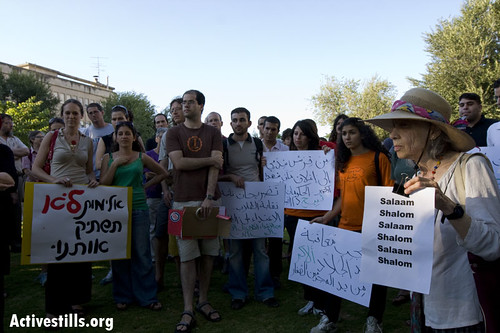
A couple of days ago, I tagged along to a rally-against-racism with my dad's leftist younger brother. The two of us joined up with a group of Jews and Palestinians gathered outside of one of the Hebrew University dorms in Kiryat Yovel, where an Arab HUJI student had been beaten up by some racist Jewish teenagers on July 16th. There was a little bit of speech-making and a little bit of shouting slogans in Hebrew and Arabic, some of which even rhymed. (Israelis are all about the rhyming slogans.) Incredibly, a couple of people showed up to oppose the rally, yelling about how Jerusalem belongs only to the Jews, and so on. And the cops were there, taking pictures of everyone who came. But as protests go, it was a very safe one — well within the green line and addressing what should have been a completely uncontroversial issue. (As opposed to the evacuation of the settlements, which... well, that should also be completely uncontroversial. But racist violence against students is really in a league of its own.)


Today, my uncle took me to visit Beit Said, the house in Jerusalem that was once owned by Edward Said's aunt, in which the famous postcolonial theorist spent a few of his early years, and which the Saids also rented out to Martin Buber! Beit Said is just an apartment today (10 Brenner Street), whose current tenants have purportedly heard of Said but don't really know anything about him. There's no plaque or anything. Anyway, Brenner street is just a short walk from my uncle's house, which is right around the corner from my grandmother's. We brought my baby cousin, who devoted some thought to the role of orientalism in the Israeli public consciousness before toddling around the playground across the street.

Who's lived here? Martin BUber, remember?
Oooo-da!

25 June 2008

Zionism: second installment

(This post is a continuation of yesterday's.)

I'd like to be able to give you my sophisticated analysis of the Palestinian/Israeli conflict. The truth is, I'm vastly underinformed about the historical, political, economic and sociological details — not for lack of information, but because I don't trust my ability to evaluate a lot of the information I have.

What I do know is that when it comes to the P/I conflict, my political priorities are in roughly the same place that they always are. I tend to be moved by arguments that appeal to individual rights, especially when they focus on the rights of the least-advantaged members of society, and especially especially when they focus on making sure that the least-advantaged possess the preconditions for secure cultural identity and political participation.

What I am not moved by are arguments that appeal to religious prerogative, ancient-historical entitlement, military security, economic efficiency, and personal safety for social elites. (At least, not when individual rights are at stake.) I won't deny that these blinders of mine are problematic. It's easy for me to blow off economic arguments; my income won't dry up if the market takes a hit. To blow off military security, given that I will never be called to serve in the armed forces [more on this another time]. To blow off terrorist attacks when I spent the spring of 2002 safe in St. Louis. Still....

My senior year in high school, I read A People's History of the United States in a US history class. The chapter on the Civil Rights Movement of the 1950s and 60s ("Or Does It Explode?") changed the way I thought about politics. No more a glassy-eyed adherent to an ideology of nonviolence and conciliation, I found myself much more sympathetic to social movements that employed violence.

I had wanted a civil rights narrative centered on a figure with whom I identified: the Caring White Person. I wanted to believe that the movement succeeded when the tender hearts of White People Like Me were roused by photographs of nonthreatening protesters — Black students who reached across the racial divide and got on the wrong side of the fire hose to testify their faith in our mutual humanity. I did not want rights to have been won by angry rhetoricians (mean!) or urban rioters (scary!). Frankly, I didn't want rights to have been won by Black activists at all. I wanted those rights to have been conferred by Benevolent Whites.
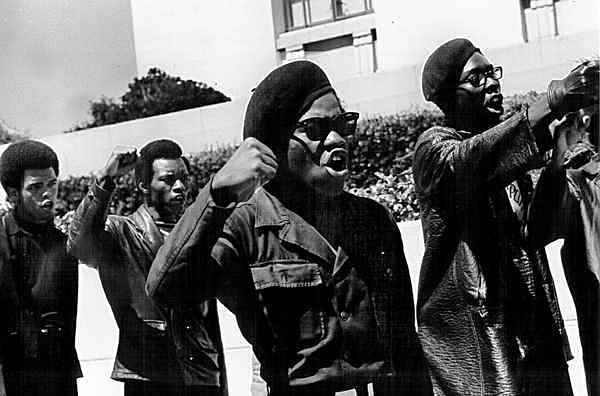

Zinn's book knocked a little bit of sense into my narcissistic head. It got me thinking that maybe it was sometimes important for people to take power, rather than just ask politely and wait to receive it. With all due respect to the nonviolent component of the movement, Zinn directed my eyes beyond MLK and Rosa Parks, to Malcolm X and Huey Newton.

The analogy between the American Civil Rights Movement and the P/I conflict is easy to overstate. The histories are different, the cultures are different, and the demands are different; the violence of Palestinian militants needs to be understood on its own terms, and not merely as a Middle Eastern analogue to Black Power. But what I'm trying to say is this: I used to think that non-state-sanctioned violence was so unambiguously immoral that it settled the case. I thought that the government should ensure, at any cost, that buses never explode.

I don't think like that anymore. I'm realizing more and more that feelings of entitlement to security and my confidence that the-authorities-are-our-friends come easy for me because US racism works in my favor. That's why security-based political arguments generally leave me cold, and probably should leave me still colder.

My understanding of the P/I conflict guides my concern to the Palestinian side. I do not know enough to make any strong claims about how, when, or precisely where the Palestinian state should be established, but I believe that the answers to those questions depend on the what and why. I am convinced that the fundamental issue here is the Palestinians' need to be free from oppression. In this context, the Israelis' need to be safe from violence takes on only a reflected, pragmatic importance.

And yet, despite all of that, I consider myself a Zionist? More tomorrow!