... all written by one guy, presumably a fan of Beitar Jerusalem (soccer).
But then at a certain point the artist (clearly the same one) goes with a more political (well, racist) message.
Gaza is a whore
and A Jew is a spirit An Arab is a son of a whore Death to Arabs!
Sports loyalty and nationalism? It seems plausible that they spring from the same graffiti-ing place inside of us.
By the way, "spirit" (נשמה) colloquially means "pretty decent person" and you can use it to address people with cool respect, in much the way you'd use "dude" or "man" in English. The first two lines of that little triplet rhyme, and have a /x/x/x/ prosodic meter, so that they practically chant themselves.
On the way to the bus, I saw (in English)
HOMOSEXUALS IS DANGEROUS FOR CHILDREN
Please take a moment to appreciate the artist's heartwarming concern for the well-being of children. Which reminds me, I have two sets of pride-march photos to post. I'll put them on the intenet just as soon as I get them off my camera!
And just to avoid being too depressing, I'll end with the night's cutest bus graffito, which was written close to the one that links the mysterious mysterious entities SXE and DXA to life and death. It laments the tragedy of unrecognized generosity:
Before I fell asleep last night, I read an idiotic blog post about aliah (Jewish immigration to Israel, lit. "ascent"). In a post addressed to American Jews, the blogger argued that the recent attempt to bomb the Riverdale Jewish Center in New York* shows that Jews in the US are extremely unsafe. She writes:
Don't you get it? America is NOT your home. You belong here in Israel. The economic problems, worries about finding a job, learning a new language, and interacting with Jews of several cultures completely different from your own, are totally irrelevant.
This lady is completely serious. I don't want to link her, but you can google the quote if you like.
As a punishment for reading stupid junk, I had a nightmare that my parents were moving back to Israel. In my dream, my grandma used her connections to get my dad a teaching job at Bar Ilan University. They were getting ready to sell the new house in Pittsburgh. It was awful. (Not, you know, because Israel is so bad. But because it is not where my parents should be, certainly not after they just made a big and difficult transition, and certainly not for the stupid reasons cited in the above-mentioned blog post.)
So just in case anyone was thinking of doing anything rash....
An American-born Jew dies soon after immigrating to Israel. An angel tells him that he is going to hell, but that he gets a choice of American hell or Israeli hell.
He asks, "What's American hell like?" So the angel answers, "In American hell, you live in a cozy house overlooking the sea, with a pool and an in-home bar, and easy access to a broad variety of restaurants serving food from many cultures. But every day at 5 p.m., a guy comes and dips you into a vat of boiling water."
The man shudders and asks, "What about Israeli hell?" The angel answers, "In Israeli hell, you live in a tiny apartment on the top of a four story building with no elevator and no air conditioning, overlooking a bus station. You eat mostly bread, boiled eggs, tomatoes, and cucumbers. And every day at 5 p.m., a guy comes and dips you into a vat of boiling water."
So the guy asks, "Why would anyone pick Israeli hell?"
The angel answers him, "well... in Israeli hell, no one really arrives at 5 p.m. In fact, the guy with the vat doesn't show up half the time because he's on army reserve duty, on vacation in Greece, or busy with his part-time cab business, or his friends took the vat to make poike on the beach.
"And even when he does show up, the water never gets all that hot anyway."
(It's still hell, though, cause there's no chummus.)
* P.S. A little bit of perspective on the attempted NY synagogue attack.
That's right! It's super-fateful grad school visiting time!
But first: culture shock! ETA: Daniel added my translation to the video! Subtitled version here...
Keren Mor: Who's last [in line]? Shai Avivi: I am. KM: Is there someone...? SA: Where? KM: Inside? Dov Navon: Some old lady. She's been in there for an hour. KM: I just have one question. SA: Sweetie, everyone just has one question. DN: I've just had one question since morning! KM: This can only happen in Israel. DN: All because of the bureaucracy... SA: In America, you wouldn't wait even one minute in line. KM: America — how can you compare? In America, the customer is always right. You can buy a shirt and return it a month later, and they'll give you your money back. DN: Here, I bought this in America. No buttons! KM: They'll give you your money back even without buttons. Even if you don't want to return the shirt, they'll still give you your money back. SA: They'll give it back and say thank you! KM: Sure, "thank you," but later they'll mug you in the street, with, with the money you got back. DN: Yeah, they'll kill you there, like, no big deal. KM: Murders and muggings, and no one even cares. You could walk around there in the middle of the street at midday and get murdered, and no one would care. You could bleed all day long on the sidewalk and no one would care. DN: Yeah, in Israel, people care. KM: In Israel! In Israel you can walk outside at night without having to worry. DN: They'll murder you! And no one will care. KM: Where? DN: In America. SA: America! In America, of course they'll murder you. But we were talking about Israel! DN: Oh! No, in Israel they won't murder you. KM: No, they won't murder you but they'll take the skin off your back with these prices, and what'll you get out of it in the end? Such small portions! SA: Ah, in America, portions are portions — enough for you and all of your friends! DN: Yeah, but, that's America. In America, there are no friends. There, it's dog-eat-dog. So what'll you do, go to a restaurant alone? And then what will you do with all the leftovers from your huge portions? KM: What, what's the problem? Just take the leftovers home. SA: Yeah, it's completely acceptable. In Israel, if you ask a waiter to wrap up your leftover food, they'll look at you like you killed somebody! DN: Yeah, and then, on the way home, they'll kill you AND take your food. KM: Where? DN: ... in America. KM: Sure! In America, no one cares! SA: In America, you can bleed in the middle of a restaurant, right into your plate — no one will care! DN: But there, your plate's be full of big portions. KM: Yeah and then they'll give you your money back and say thank you! SA: In Israel, if you bleed in the middle of a restaurant right into your plate, they'll look at you like you killed somebody! DN: Well yeah, it's completely acceptable. SA: Where? DN: In America — KM: In Israel — DN: — err, in Israel — KM: — in America — SA: In America, if they raise the prices, people take to the streets. DN: True, but they can get murdered in the streets. KM: Sure, but who cares? No one. SA: In Israel, people won't ever take to the streets. DN: And even if they do, no one will murder them. KM: And if they do get murdered, everyone will care. SA: Where? DN: ... In America. SA: What shit. KM: Where? SA: In Israel. KM: Ah. DN: But not like in America. SA: Well, America! How can you compare? [sigh] DN: [sigh] KM: ... Who's the doctor?
Despite indications to the contrary, I survived the war. (Whew!)
The real reason for my bloggy silence is that I have had nothing sufficiently important to procrastinate about. Semester-א ended on February 6th, and Semester-ב only starts tomorrow. I've been on vacation!
Now, just to be clear: there are no real breaks between semesters in Israel. Instead of having reading week, finals week, and then vacation, the exams are spread across a whole month, right up until the day before classes resume. In fact, it's even worse than that. All of this is just "Mo'ed Alef" (the first round of exams). If you want to improve your score, you're guaranteed an opportunity to retake the exams: "Mo'ed Bet". And if you're not sure you're ready for the exam when the exam date arrives, you can take it on the retake date, and you're guaranteed another retake date even later on. That's right, "Mo'ed Gimel." I think there's even a "Mo'ed Daled," for students who get called away to reserves service during the earlier rounds of exams.
Consequently, pathological procrastinators wind up smearing one semester's exam period into the following semester. The guy I dated over the summer couldn't go home for Rosh Hashana because he was still studying for last year's semester-ב exams.
So during the break all the Serious Hebrew U Students were busy with a never-ending stream of exams. Meanwhile, I took the opportunity to travel and have adventures around Israel! The Center for the Study of Rationality took all of us on a retreat to the Galillee and the Golan Heights, where we investigated rationality, hiked, and thorougly celebrated Tu B'Shvat with wild hotel-room parties. Just after I got back, I took off again and drove half the length of the country on an off-roading jeep trip with my uncle. I crashed with Jessa and her cousin Suzie for a few days at the University of Haifa, hung out in Tel Aviv and Rehovot with Garth, had a cookout with Katey & Dan on the roof of a dorm at Weitzman and spent a few days chilling with Rotem's family in Nes Tziona.
After that, I was supposed to go on a ʇɥbıɹq1nɟ-sponsored trip to the north of Israel, but my body decided it was time to catch a respiratory virus and a digestive bug, and have a total blue-screen system meltdown. I took my packed bags — actually, Rotem took them for me — and crash-landed at my grandmother's house, that well-known middle-east TLC hotspot. A week and a half and a million cups of tea later, I'm coughing but otherwise fully recovered. בשעה טובה!
One of the best reasons to learn a second language is that different languages carve different conceptual spaces. When you learn more than one language, you start to see that the concept-bundles expressed in your lexicon aren't as natural and inevitable as they might have otherwise seemed.
For example, Hebrew has two words that fill the space of the English "independent":
"עצמאי" is derived from the root ע.צ.מ. (which means self or essence). This is the word you'd use for "independent research" or "Independence Day." And then there's...
"בלתי תלוי," i.e. non-dependent — which is the word you'd use for "independent variable" and the like.
When your language forces you to make this distinction, you learn to track a conceptual difference between the sense of "independent" that contrasts with "dependent," and the sense that connotes self-reliance or autonomy.
Here's another one I often mess up. There are four words that do the job of the English word "class" (in the educational context):
"כיתה" ≈ classroom ("The blackboard's at the front of the class.")
"קורס" ≈ course ("I'm going to sign up for this class.")
"שיעור" ≈ lesson ("I have to get to class.")
"שכבה" ≈ level ("She's in my graduating class.")
A decent English dictionary would distinguish these four senses of the word "class," but judging by how often I choose the wrong word in Hebrew, my English lexicon doesn't give me a sturdy handle on the distinctions. It's not as if I think in terms of class-1, class-2, class-3 and class-4. I've been bundling them together, and when I speak Hebrew, I have to make a special effort to tease them apart.
If you know me, you can guess where I'm headed: Sometimes languages make conceptual distinctions that encourage Bad Framing. Handy example: English doesn't have a one-word label for a promiscuous person, or an unmarried person. In both of these cases, it divides the concept into a male category (pimp, bachelor) and a female category (slut, spinster). And our patriarchal notions about gender performance infect these gendered terms with contrasting connotations, clouding our moral vision, et cetera.
Moral cataracts are easier to spot when they're not on your eyes. So when Hebrew's problematic conceptual distinctions glare out at me, I try to remember that I live in a glass house. With that disclaimer out of the way, let me just throw this one stone...
Hebrew distinguishes between propaganda (תעמולה) and "explanation"/Hasbara (הסברה). Propaganda is what Arabs do when they use skewed political analysis and gruesome images to rally the world to against us. Explanation is what Israel does when it publishes sympathetic political analysis and powerful images to help the world understand what we're feeling? Deep down inside? (... What?)
I mean, how would you feel, if someone throws on you טיל [a rocket]?
Hebrish rap from Israel's fantastic sketch comedy show, Eretz Nehederet To watch it with English subtitles: click on the triangle icon at the bottom right corner of the viewer, and select "CC."
There's been a lot of talk about Hasbara on the news. How'd we do this time? Could we do better? How will we confront the Hasbara challenges of the coming weeks? (Hasbara challenges are soon-to-be-published facts, like death counts in Gaza. We'll address that one by painting Israel's soldiers as the true victims: "Hamas forced them to kill civilians! Our boys shed a tear as they pulled the trigger!")
I don't know if the discourse would be any different without this absurdly transparent euphemism. I like to think it would.
The main emotion I remember feeling on September 11th was confusion. It was obvious that a significant event had occurred, and I floundered for cues about its precise significance for me (my family, the country, etc). The first few days of Cast Lead were much the same. And at this point, this war has changed my life in about the same way that the war on terror (or the war on Iraq) changed my life. It's something to talk about.
[I should note, for the sake of completeness, that the war has hit much closer to home for my male friends, many of whom have been in and out of reserve service over the past three weeks. Niv's in uniform for 24 hours out of every 72 and Sarel's been at the border for over a week.]
It's not that I don't care. (I care! a lot!) But if you were to make a movie about my life over the past month, you wouldn't need special effects. I ride the bus to class, I work on application essays, I go to plays and concerts, and I cook dinner with a very handsome dude. Last weekend, I visited ʇɥbıɹq1nɟ friends in Rehovot. We went to a campfire cookout with Rotem's crew on Friday night and drove to Giv'at Brenner for hummus on Saturday. Yesterday, Rotem and I joined up with a youth group for a day-long orienteering trip. My philosophy class has been reading about religious conscientious objections from military service, and today we'll review excerpts from a book called "Terror in the Balance." There have been a lot of war conversations, and lots of regular conversations too.
All this talking haven't given me much clarity. War conversations are usually thick with rhetoric and implicit premises. But there's one thing that I almost always find myself saying:
I don't have accurate information about what exactly we're doing in Gaza (or exactly how, or exactly-exactly why) — and even if I did, I wouldn't have the tools to evaluate whether it is an effective component of a just, peace-seeking strategy. But from what I do know about the government/military institutions charged with making these decisions, I have serious doubts both about the war's effectiveness and its legitimacy.
These articles have also helped to clarify my thoughts. (Hans sent me the first and the third; the second article was mentioned in Leiter's blog.)
Who the perpetrators and victims are of "terrorism" is almost always a function of who is wielding the term rather than some objective assessment. Aimlessly shooting rockets towards civilians (as Hamas and Hezbollah do) and dropping bombs from 35,000 feet that you know will slaughter many civilians while viewing that slaughter as a strategic benefit (as Friedman advocates) are acts that have far more in common with each other than differences.
Israel’s leaders remain determined to control all of what used to be known as Mandate Palestine, which includes Gaza and the West Bank. The Palestinians would have limited autonomy in a handful of disconnected and economically crippled enclaves, one of which is Gaza. Israel would control the borders around them, movement between them, the air above and the water below them. The key to achieving this is to inflict massive pain on the Palestinians so that they come to accept the fact that they are a defeated people and that Israel will be largely responsible for controlling their future.
I can't answer the question of proportionality. The fact is, nobody has ever proposed an operational test of how you weigh a military objective against "collateral damage"— our antiseptic euphemism for dead and maimed civilians who were at the wrong place at the wrong time.... But let's be clear about this: proportionality only comes in when the targets are legitimate.... If Israel is targeting all the institutions of Hamas's civil government of Gaza, including all those who work in those targets, it seems to be going after civilians ... according to the law of war as Israel's own Supreme Court understands it. If that's right, the attacks are illegal even without reaching the question of proportionality.
One more thing. Some twelve-or-so years ago, a Gazan gynecologist named Dr. Izzeldin Abuelaish considered pursuing a medical fellowship in St. Louis. He was in contact with my dad then, and even though he didn't wind up coming, he sent our family "happy and peaceful New Years" greetings for years. On Friday, the Israeli army shelled Dr. Abuelaish's building and killed his three daughters.
This all happened about 60 miles from my house. You know you're in the first world when the earth breaks open at your doorstep and your carpeted floor doesn't even shake.
This chocolate is too sweet. Do you want it? No, it's nauseating. Then I'm throwing it away. You mustn't throw away food! Do you want it? No. So what am I supposed to do? Donate it to... ...hungry children in ... Gaza! ... Sderot!
Epilogue: Gaza? Between the two, I think the kids in Gaza have a more serious shortage of chocolate. Sure, but they're busy serving Hamas as human shields. Maybe if we gave them more chocolate they'd busy themselves with something else. [beat] This sucks.
Sarel and Ariela drove me and Rotem to school on Wednesday. We arrived shivering, blinking at the rain and squishing through soft orange mud in the unpaved parking lot. Sarel announced that this is his favorite weather: cold, wet and gray. "If it were up to me, I'd keep the weather just like this all year!"
We look at him incredulously. "At least the rain is good," Ariela submits. (Israel's perpetual water shortage is especially severe this year, but as usual, the Territories are bearing the brunt.)
"Indeed!" Sarel continues, "the rain is not only good, but! Moreover! It is healthy for the plants!"
Rotem cites Arik Einstein: "צבי אומר שגשמים כאלה מזיקים לחקלאות / Tzvi says that rains like these impede the agriculture."
Sarel: "And who's Tzvi?"
Ariela and I giggle. "You need to work on your cultural knowledge," she says. (She's right. The song Rotem quoted is like Brown Eyed Girl — everyone knows it.)
ואני חושב עוד מעט זה עזה, ורק שלא יעוף איזה רימון, ונלך לעזאזל. סע לאט. סע לאט.0
And I'm thinking, soon enough it'll be Gaza, and just don't let some grenade fly and send us all to hell. Drive slowly. Drive slowly.
Niv's programming; I'm applying to graduate school.
Today's Galgalatz1 playlist is a little different. In honor of Arik Einstein's seventieth birthday on Saturday, they're scattering some more of his songs through the playlist. Between tracks, the DJ wishes us a "Happy New Civil Year" and reminds us to obey the Home Front Command2 and get in a shelter within 15 seconds if we hear a siren. And there are these ads.
Since July, the National Road Safety Authority has sponsored a heavy radio campaign reminding drivers to stay focused. The ads have a roleplay structure: someone's describing the great day they're having, and then you hear a crash, and a dark voice says,
Even a dreamy day can end in tragedy. There is life in the streets. Pay attention when you drive. The National Road Safety Authority.
Today, the army's playing similar roleplay commercials. A young couple is having a telephone conversation. She asks what he's doing, and tells him she's worried. He says that he's not supposed to tell her.
"But I'm worried about you!" "Okay, just so that you won't worry. My mission is to..."
Then there's static noise, and the familiar dark voice says,
Revealing military secrets is forbidden by law. Unprotected cellphone lines can threaten our soldiers. Do not expose secure information.
I raised an eyebrow at Niv. "It's a military radio station after all," he said.
A few minutes ago they interrupted "קח לך אישה" (the chorus is "find yourself a wife, and build her a home") to announce rocket threats in Ashdod. I joked about building her a bomb shelter. At the end of the song, they announced that Ashkelon is also under fire, and put on "All You Need is Love."
Ashkelon is a little town in the South, just 10 miles from Gaza strip. Niv grew up there. His parents still live there, and he calls their house home. The house is empty now; his parents have been staying with Niv's brother in Tel Aviv for the past five days. On the first day of the operation, Niv was home for Hannukah. Instead of doing doughnutty, candley Hannukah stuff, he watched his mother pack, sobbing. Then he got a call from a blocked number. The Navy was rousting him for emergency reserves service. "I just want my parents to be able to live in their home without being afraid of rockets, you know? When I saw my mom crying, I was ready to kill them all, I didn't care. It took me a while to get a grip on myself."
Two minutes ago, Niv's phone rang with an unidentified number. He asked me to answer for him, to make sure it's not the military. He just can't do reserves today. (He's already been scheduled for next week.)
Nitai is got called in today. Sarel has been warned that if they start a ground invasion, his unit will be among the first they deploy. Elad was in the infantry in Lebanon. He's afraid of answering his phone.
"Mr. Tamborine Man" was interrupted: alarms in Sderot.
1GalGalaTz is one of two Israeli army radio stations. (The other military station is Galei Tzahal, aka GalaTz. Galgalatz is a play on words: "gal" means wave; "galgal" means wheel, as in traffic reports — the original telos of the secondary military station.) 2 In Hebrew, it's called פיקוד העורף — literally, "Nape Command."
04 December 2008
A couple of nights ago, I came home from Hebrew U late at night. Walking down a paved path on campus between bushes and groundcover, I met one of these guys.
That's not my photo. I wouldn't have been able to catch the thing on camera. It was very dark out, and I was listening to This American Life on my headphones, so I almost missed him. Suddenly, just a foot or two away from me, I notice this black shadow that materializes into enormous rodent, and my heart stops. He's eating something and sniffing around like a dog, and his back and tail are covered with huge long spines.
I used to have a hedgehog. My hedgehog was adorable. The Hebrew U porcupine was not adorable. He was huge and ugly and scary as hell.
I backed slowly up the stairs on the path and up the hill, where I could watch the porcupine and catch my breath. He didn't seem to have noticed me. When he lumbered off the path and into the bushes, I marched slowly and loudly past him, so that he wouldn't think I was sneaking up on him and get startled.
The rest of the way home, I reflected on the way that I experience and process potential threats. Lots of times I've been on a bus and heard a loud bang, or walked along a road and had a guy yell at me from a car window. I get a rush of adrenaline and time slows down until the apparent threat dissolves. And then I take a moment to think about what I would have done, and I realize that there's no answer. Even if I recognized an attacker before he confronted me, I would still not be able to protect myself.
I've found some focus and direction in my research — I'm closing in around the idea of trust. Trust is relevant to game theory (which deals with stuff like the credibility of promises and threats) and because there's a lot of new philosophical literature about it (including feminist-y analytic philosophy, which is My Favorite).
I met with a philosopher here, who referred me to a couple of philosophers who are working on the rationality of trust, and suggested a few ways getting involved in department life.
I got a great compliment from one of my professors after seminar:
"You're Hans's student? That explains a lot."
And then he suggested that we meet as soon as possible so that he can help me with my grad school applications. (!)
I came home to a lonely, lonely dinner alone... but then my roommate Niv came home and we gossipped and made sushi.
And then when I was about to go to sleep, I checked my email and
A girl from my philosophy class invited me to her birthday party! (Isn't that, like, the ultimate token of social acceptance?)
איך יהיה אדם ראש עיר כזות? מה יעשה בה? יבנה ויבנה ויבנה.
ובלילה יקרבו אבני ההרים מסביב אל הבתים, כמו זאבים הבאים לילל על כלבים שנעשי לעבדי בני האדם.
יהודה עמיחי
Mayor
It's sad To be the Mayor of Jerusalem. It is terrible. How can any man be the mayor of a city like that?
What can he do with her? He will build, and build, and build.
And at night The stones of the hills round about Will crawl down Towards the stone houses Like wolves coming To howl at the dogs Who have become men's slaves.
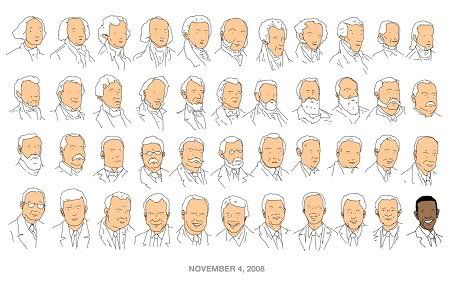
In my American-media-gorging over the past few days, I hear a lot of Americans proudly claiming that "it couldn't have happened anywhere else in the world." Out here in The World, people really are posing the question. Could what happened in the US on Tuesday have happened here in Israel?
Is that question even sensible? What would count as the "same thing" happening here?
photo credit: NYT, from a May 13 Yom Ha'atzmaut event in DC
Let me postpone the central and fascinating racial issue for the next post. Before I get there, there's another difficulty: Israel doesn't have a directly-elected head of state. Israel's president is a symbolic figurehead, elected by the Knesset, and the prime minister, though formally appointed by the president, is actually just the leader of whichever party wins the most Knesset seats. (Fascinating Fact: Israel actually implemented an American-style head-of-state direct-election system from 1996 to 2003, but then they scrapped it and reverted back to the earlier system.)
People do directly elect political parties, and some political parties are explicitly designated as representing the interests of particular minorities. For example:
and Israel Beiteinu (racist immigrant Jews from Russian-speaking countries?)
So someone could plausibly suppose that a US08-equivalent Israeli election outcome would be a Knesset where a plurality of seats are held by a party like UAL, Shas or maybe Atid Echad.
In fact, it's not so at all. The demographically-oriented Israeli political parties take care of their own. So when Obama said, "I may not have won your vote, but I hear your voices, I need your help, and I will be your President too" — he was articulating an American conception of political constituency. By contrast, Israel's minority parties are understood as responsible to their electorate, and maybe even to their whole demographic base... but not to the whole country. So long as they hold few seats in Knesset and are forced to bargain hard for political gains, that's fine. But no reasonable Israelis are fantasizing about a Shas-led government.
What people are imagining is a political victory by a major party headed by a suitably-Obama-ish prime minister. And what does that PM's Obamaishness consist in? S/he's got to belong to a minority whose status in Israeli society is somehow equivalent to that of Black Americans. And that opens up a truly fascinating question: does Israel even have plausible analogues for US racial categories?
Working in my room, I heard a noise near the closet. I peered over anxiously, expecting a to see roach or a mouse. After looking around for a little while, I went back to work, only to see a gecko disappear under my bed.
Hm. Neither an insect nor a rodent? How am I supposed to feel about this?
Speaking of scurrying, go vote for אובאמה! Especially if you're voting in Colorado, Pennsylvania or Virginia. Here's one excellent reason. (Hit "refresh." There are more.)
In case you need something to watch until the results come in, here are of my favorite election videos:
Last week, my grandmother and I went to the Lev Smadar cinema in the German Colony to see Waltz with Bashir, an animated film that explores themes of war, trauma, cruelty and innocence through interviews with IDF soldiers who witnessed the Sabra and Shatila massacre.
It took me and my grandmother two tries to see this movie. The first time, the theater was actually showing Caos Calmo instead. Since the Smadar is a one-theater cinema, we bought tickets for "the movie" at the box office. We didn't realize we'd made a mistake until, several minutes into the movie, it dawned on us that the live-action Italian film we were watching really was the main feature. (20 minutes in, my grandmother leaned toward me and said, a little too loudly, "I don't think this is Waltz with Bashir!") But we decided to relax and make lemonade from the lemons we'd been dealt, as they say. We'd come back for Waltz with Bashir another time.
This is all by way of saying: Waltz with Bashir was incredible. I was expecting something like Waking Life (which I found disappointing). But in fact, this film was more like an Israeli Grave of the Fireflies. I think everyone should watch it, but particularly those of you who are interested in genocide, or the military, or Middle Eastern politics, or the psychological effects of trauma.
Here's a trailer, in case my sales pitch didn't convince you:
Two days ago, I got an email from LRS, asking when she might be able to come visit. (!!) I answered:
Can I get back to you on that one?
The semester was scheduled to start on Sunday, but the university has informed the students that the semester will be delayed "until further notice."
Two years ago the whole school year was delayed by a student strike over raised tuition; last year the already-delayed school year was pushed back even further by a faculty strike over low wages. This year, the institution of higher education itself announced that it's striking for a bigger cut of the national budget, but...
Well, a few weeks ago the old Israeli prime minister (Ehud Olmert) stepped down because he was mired in a huge financial scandal, and the governing party elected a temporary prime minister (Tzipi Livni) to replace him. But she only gets to stay prime minister if she can put together a new parliamentary coalition before a certain deadline. The deadline was two days ago, and she couldn't do it, so now Olmert is back in power, leading a transitional "care-taker" government until the ad-hoc elections, which I think are scheduled to be in February (to give everyone lots of time to campaign). [Here's the relevant Wikipedia article, with a much better explanation than mine.]
I'm pretty sure that the care-taker government does not have the authority to authorize budgetary changes. If so, the university had better not strike, since no one will have the power to meet their demands anyway! Hopefully they'll step down in the next few days, and start the semester on schedule, and then I'll know — at least tentatively!! — what this year's academic schedule is.
It turns out I was wrong about the legislative power of the care-taker government. Yesterday morning, as I got on the bus to the market, I heard the news on the bus driver's radio: "Emergency budgetary changes approved, academic semester to begin on Sunday." Sure enough, on his third day back in office, Olmert called an emergency budgetary session and approved the budgetary changes that the universities were asking for.
That's the actual budget meeting! Not my photography, haha.
Sure enough, this appeared in my email inbox yesterday night:
No explanations or apologies. Just one line:
"On Sunday, 11/2/2008, the 5769 school year will commence on schedule."
Which means my academic semester will officially begin at 4:30 on Sunday, with "Between Law and Moral and Political Philosophy." Or for short ... ?במלאפ"ף Bamla'apaf? Come to think of it, what in the world are the students going to call this class?
As you know, Bob, culture shock is a central component of the study-abroad-experience. Still, my own personal culture shock is shaped by the fact that I spent the last four years living in one of these:
The 1500 students at my liberal arts college were far from univocal when it came to identity politics, but we all had a sense of common ground to push off of in our disagreement, including a mostly-shared conception of tolerance and more-or-less similar ways of conveying respectful disagreement. Predictably enough, now that I'm out of the bubble (and outside my national bubble, and lately outside of the academic bubble) I've been finding myself frustrated with the rift between the assumptions I make and those that some of my Israeli partners in conversation make when we talk about identity politics.
Did you need any confirmation that I'm a philosophy dork? Now you have it.
When people find out that I study philosophy, they'll often ask what I plan to do with my education. I have a few canned responses to those kinds of questions — most of which are just cheerful concessions — but the most honest response is that philosophy clarifies my understanding of my circumstances in a way that is very important to me. The experience of reading this book here in Israel has offered me a great reminder of how important a role philosophy plays in my personal life.
A few encounters with rough edges of Israeli culture — especially in conversations about identity-politics — have left me struggling to find a balance between respect and resistance. It's sort of like learning personal-space boundaries in a new culture (how far to stand from someone when you're having a conversation, or how long to hold a handshake). Except in this case, I'm learning how far to stand from my own heart, and how much to thicken my skin, cool my blood and respond indifferently to (what-strikes-me-as) prejudice or intolerance. [Ruth blogs a similar struggle in Syria.]
The frustration and disappointment that I feel after these sorts of encounters has been hugely compounded by the fact that I don't know what kind of behavior I expect from myself in a situation like that. It's one thing to make judgments and keep them to myself. But the whole mutual-understanding-between-cultures thing seems to demand that I refrain from imposing my culture's value judgments on others. How can I refrain from making judgments without betraying my moral commitments?
And that's where this book comes in. I'm just going to be self-indulgent and quote it at length, because this particular section helped me so much to understand where my frustration was coming from, and where I hope to go from here.
To be fully tolerant does not entail that we cannot have critical reactions to the content of the attitudes, thoughts or conduct of those tolerated. All forms of tolerance necessitate having critical reaction to that which we tolerate. Otherwise, we would be either totally indifferent, complacent, world-weary, or fully accepting. Nor should "critical reactions" be limited to private, unexpressed responses. The fully tolerant do not — as do the barely and merely tolerant — deny themselves the opportunity, even the responsibility, of critically engaging those whom they tolerate, for the fully tolerant value more than that one lives one's own life. [...] It is enormously important that one's life has value, not merely that it is one's own.
Because those with a liberal temperament value individuals trying to live out their own conceptions of a good life, we might sometimes help individuals and groups pursue their good even when we find it deficient in various ways. [...] Full tolerance, therefore, involves a deep respect for the individuals and communities whose life projects are different from on's own, even where one disapproves of elements in it, even thinks that it is a generally inferior way to live. Full tolerance is not acceptance. The fully tolerant recognize, however, that it is usually difficult to remove objectionable elements from a system without destroying the whole. They will be acutely aware of what I call the "Sweater Principle": We sometimes pull on an offending bit of thread marring our sweater only to find a shapeless heap of yarn at our feet.
The fully tolerant, finally, recognize that there can be much good — though a diferent good — in attitudes, beliefs, and ways of life that we ourselves do not find congenial. It is not htat we do not see what is regrettable, say, about an Amish way of life. We see that all too clearly.What we may overlook are the incredible strengths in that way of life, the values — again, perhaps markedly different from our own, maybe even in competition with them — that it instills. Their way of life is not ours, but we see that it enables Amish to live rich, constructive live. This does not mean that the Amish themselves are imbued with a liberal temperament. Having a liberal temperament is neither a necessary nor a sufficient condition for living a worthwhile life. Having a liberal temperament, however, can help one see the value in ways of life and systems of belief that are not, themselves, liberal in any respect.
My last post (so long ago!) drew worried comments from some Americans who like me and worry that I might never come back. Aww! Let me assuage your fears with a blurry graph:
That's from the tail end of the ʇɥbıɹq1nɟ orientation in DC. The graph's titled "Pattern of Adjustment," and it plots Satisfaction against Time. (What are the units on the y-axis?!) As you can see, we visitors of foreign cultures predictably become infatuated with our host country, and then our moods come crashing down into the Valley of Great Dissatisfaction, from which we eventually emerge... only to plunge into the Even Deeper Valley of Horrible Sadness when we experience reverse-culture-shock back at home.
Fellow-fellowshipper Mitch-in-Egypt puts it this way — "Being in Cairo like being in a relationship with another person.... You might find it fascinating in the beginning, and then not so much later on."
It's not just Cairo, of course. I find myself marking little benchmarks-of-culture-shock.
Random feral cats all over the place? No longer the Cutest Infestation Ever. The more dead/starving/diseased street cats you see, the less you want to snuggle up with the healthy-looking ones. I was walking around Jerusalem yesterday and saw part of a cat lying in the middle of an intersection. There was nothing cute about it.
The thrill of public transportation? Basically gone. I think that I lost my appetite for bus travel after I spent 50 minutes shivering in the windy Jerusalem dusk while I waited for line 17, which (it turns out) takes the longest possible route between Beit Hakerem and Rechavia. I could have walked it and gotten there almost twice as fast.
And the classic Israeli game of shoving your way onto the bus becomes much less fun after you lose, and get stuck waiting another twenty minutes for the next bus.
Gefilte fish. I do not have very much to say about it, except that I really hope I stop being sick of it in time for Passover.
That's my grandma, making gefilte fish by grinding up fish into little shivering worm-like things. Honestly, my grandmother's gefilte fish are amazing, but we ate them for breakfast lunch and dinner throughout the עשרת ימי תשובה period.
Aggressive flirting from random dudes, especially dudes who are trying to sell you something? Not even mildly amusing anymore.
Except, okay, there was one time when I got on a train and I really wanted to be left alone, so I sat across from an oldish guy who was wearing a white shirt and a black velvet kippah, which normally signals a strong predisposition against chatting up girls in tanktops. As I sit down, the dude announces a heavy Russian accent that his name is Moshe and he "needs to get married very urgently," and gives me his card, which is actually just a piece of cut-out printer paper advertising his services as a "therapeutic masseuse for men only." That... was pretty amusing. But still: random dudes, cut it out!
If you don't know why I chose a photo from Machane Yehuda for this one, you have probably never been a 20-something-year-old woman at Machane Yehuda. For every obnoxious remark from a sales-dude, I think a customer-lady should be entitled to a date. (The fruit kind, not the other thing.)
But most of all I am getting worn down by a bunch of conversations I keep having, which generate a lot of friction and never seem to get anywhere. Chief among these are:
Arabs / Muslims / Palestineans: their dispositions, their cultural contributions, etc.
Feminism.
התבוללות (intermarriage between Jews and gentiles).
I don't want to avoid these conversations — and anyway, I can't — but I need to find a way to have them more productively.
A conversation
-
At the vet's office today, I called my mother to ask some advice on how to
deal with a very sick kitty.
M: "Micaya, you can't spend that much on a cat rig...
Your wish can come true...
-
Anabelle and Maria were wishing really hard for one last time to visit
Disneyland before the big move to Boston. Their wish was granted thanks to
Nate's ...
-
This thing is extremely hard to keep up!
It seems all be Hungry for math a few months longer than originally
planned... Somewhat out of the blue, A Multina...
"Moments."
-
As you can imagine, the most popular question I've been asked is: "how was
Israel?".
Even though I've been asked approximately 14,000 times, I still don't ...















 Posts
Posts


